

SoFi Technologies (NASDAQ: SOFI) has officially unveiled 'Big Business Banking', a groundbreaking enterprise-focused service designed to eliminate the operational friction between traditional fiat finance and digital asset management. Operating as a nationally chartered bank with over 13.7 million members and $50 billion in assets, SoFi is leveraging the high-speed Solana blockchain to empower large corporations to manage both cash and cryptocurrency within a single, highly regulated ecosystem.
The Evolution of Enterprise Banking Operations
The launch of this comprehensive platform represents a monumental integration of blockchain technology into the foundational infrastructure of a major United States financial institution. For decades, global enterprises have been forced to navigate a fragmented financial landscape, relying on a patchwork of legacy systems, correspondent banks, and third-party payment processors to manage their international treasuries.
By merging its robust, regulated banking framework with decentralized network architecture, SoFi aims to provide enterprise clients with an unprecedented suite of tools for real-time treasury management, instant cross-border settlements, and secure digital asset custody. This hybrid approach allows multinational corporations to maintain the compliance and security of a traditional bank while harnessing the speed and borderless nature of cryptocurrency networks.
Breaking Free from the 9-to-5 Legacy System
A primary focus of the new 'Big Business Banking' offering is addressing the severe scheduling limitations inherent in traditional banking systems. Legacy financial institutions typically process transactions, clear funds, and finalize settlements only during standard business hours, Monday through Friday. This antiquated schedule creates massive friction for global enterprises that operate across multiple time zones and require continuous, uninterrupted access to their liquidity.
To be competitive, businesses today must operate in a global, always-on environment 24 hours a day, 7 days a week, while legacy banks typically still operate 9 to 5, Monday to Friday.
SoFi CEO Anthony Noto highlighted this operational disconnect during the platform's highly anticipated introduction. According to Noto, the demands of modern, digitized commerce have vastly outpaced the infrastructure of traditional finance. The Big Business Banking platform is specifically engineered to obliterate this dynamic, combining the strict regulatory foundation of a nationally chartered bank with the immense scale and flexibility that modern companies require to move capital in real time.
SoFiUSD and the Power of Solana Integration
By integrating directly with the Federal Reserve and deploying modern blockchain technology, SoFi is providing its enterprise partners with a unified financial command center. The platform elegantly consolidates operations that previously required multiple distinct service providers—such as payment gateways, crypto exchanges, and custody providers—into a single, intuitive interface.
Key Platform Capabilities
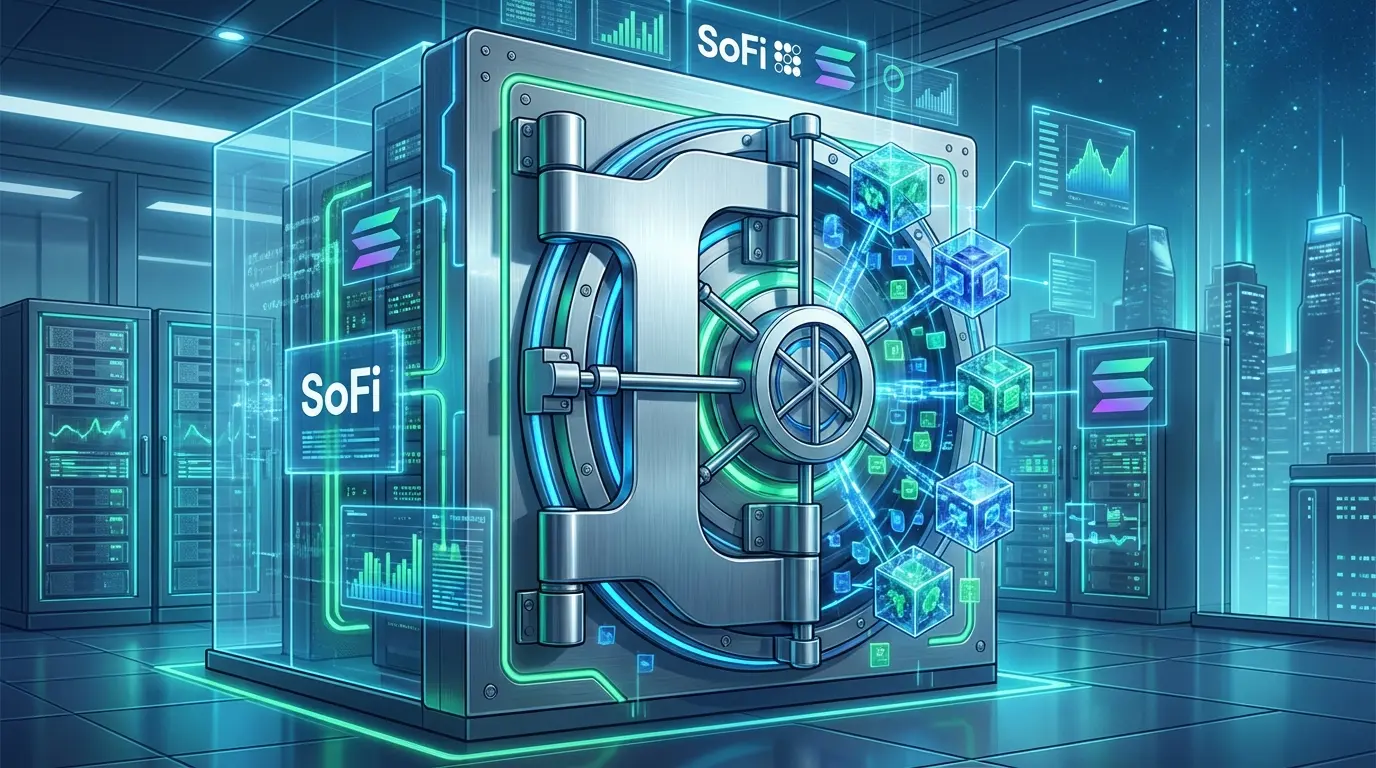
The platform features 24/7 real-time settlement, institutional-grade regulated deposit accounts, and instant fiat-to-crypto conversion via the proprietary SoFiUSD stablecoin, all operating seamlessly on the Solana network.
A core feature of the service is the provision of regulated deposit accounts. These high-capacity accounts are meticulously designed to keep corporate funds within a strictly regulated banking environment, providing essential institutional safeguards. According to industry reports, this structure allows businesses to maintain regulated deposits without the operational fear of unexpected bank freezes—a critical issue that has occasionally plagued crypto-native firms relying on hesitant traditional banking partners.
The Mechanics of Minting and Burning
The platform facilitates true 24/7 real-time payments, allowing companies to deploy capital continuously, regardless of weekends or bank holidays. Clients can execute rapid transactions using traditional cash, selected blue-chip cryptocurrencies, or the bank's newly introduced proprietary digital dollar, SoFiUSD.
To support instant asset conversion, the platform incorporates a sophisticated "mint and burn" mechanism for SoFiUSD. This functionality allows businesses to convert between fiat cash and digital assets instantaneously. SoFi backs the token dollar-for-dollar with its regulated balance sheet and utilizes it as a high-velocity settlement asset across the Solana network. This provides enterprises with a direct, frictionless bridge between traditional bank deposits and on-chain decentralized liquidity.
Strategic Ecosystem Partnerships Driving Adoption
The ambitious rollout of the Big Business Banking platform is supported by a formidable consortium of industry heavyweights spanning traditional finance, digital asset custody, market making, and decentralized finance (DeFi). Initial participants in this expansive ecosystem include globally recognized names such as Mastercard, Galaxy, BitGo, Fireblocks, Cumberland, Bullish, B2C2, Wintermute, Jupiter, and Mesh Payments.
This partner network meticulously covers every critical aspect of the digital asset lifecycle. Firms like BitGo and Fireblocks provide the institutional-grade custody and cryptographic security infrastructure required by risk-averse corporate treasurers. Meanwhile, entities such as Cumberland, Wintermute, and B2C2 offer the deep market-making and liquidity services strictly required for executing large-scale enterprise transactions without causing market slippage.
Securing the Institutional Framework
The inclusion of Jupiter, a prominent decentralized exchange (DEX) aggregator native to the Solana network, is particularly noteworthy. It indicates a direct, integrated connection to native on-chain liquidity pools, allowing institutional capital to flow seamlessly into the DeFi ecosystem. The platform's core infrastructure relies heavily on the Solana blockchain, which is widely celebrated in the industry for its unique ability to process thousands of transactions per second with sub-second finality and fraction-of-a-cent fees.
While Solana serves as the primary foundational network for these high-speed operations, SoFi has prudently indicated that the platform is architected to leverage other blockchain networks in the future. This multi-chain approach will ensure broad ecosystem compatibility, network redundancy, and risk mitigation for enterprise clients.
Market Context and Financial Implications
Additionally, SoFi has established a separate, highly strategic partnership with global payment processor Mastercard. This landmark collaboration aims to integrate SoFiUSD as a recognized, trusted settlement option across Mastercard's Multi-Token Network. This integration has the potential to exponentially expand the utility and reach of the bank's digital dollar far beyond its immediate ecosystem, embedding it into global point-of-sale and B2B payment flows.
The introduction of this comprehensive enterprise platform follows previous, calculated steps SoFi has taken to weave digital assets into its regulated banking operations. In November 2025, SoFi made headlines by becoming the first FDIC-insured national bank to offer retail cryptocurrency trading directly to consumers, allowing everyday users to buy, sell, and securely hold digital assets including Bitcoin, Ethereum, and Solana within their standard banking app.
Retail Precedents and Stock Market Reaction
Despite the groundbreaking announcement of the comprehensive enterprise banking solution and its extensive, star-studded list of institutional partners, SoFi's stock experienced a slight downturn in the immediate aftermath. Market data indicates that SOFI shares fell by 2.4% during Thursday's trading session following the unveiling of the 24/7 Big Business Banking platform.
Financial analysts suggest this minor dip may be attributed to broader macroeconomic factors or short-term profit-taking, rather than a rejection of the technology itself. Institutional integration of blockchain technology is often viewed as a long-term play, and the immediate revenue impact of enterprise software rollouts can take several quarters to materialize on a balance sheet.
The Future of Regulated Digital Asset Management
Looking ahead, the company has explicitly stated that the platform will continue to aggressively develop its multi-chain capabilities. As the service officially rolls out to enterprise clients in the coming months, the financial technology sector will be watching closely to see how traditional corporations adopt these blockchain-native treasury tools.
If successful, SoFi's Big Business Banking initiative could serve as the ultimate blueprint for how nationally chartered banks interact with decentralized networks. By successfully bridging the rigorous compliance standards of traditional banking with the unmatched efficiency of the Solana blockchain, SoFi is not just launching a new product—it is potentially setting a new global standard for the future of corporate finance.