

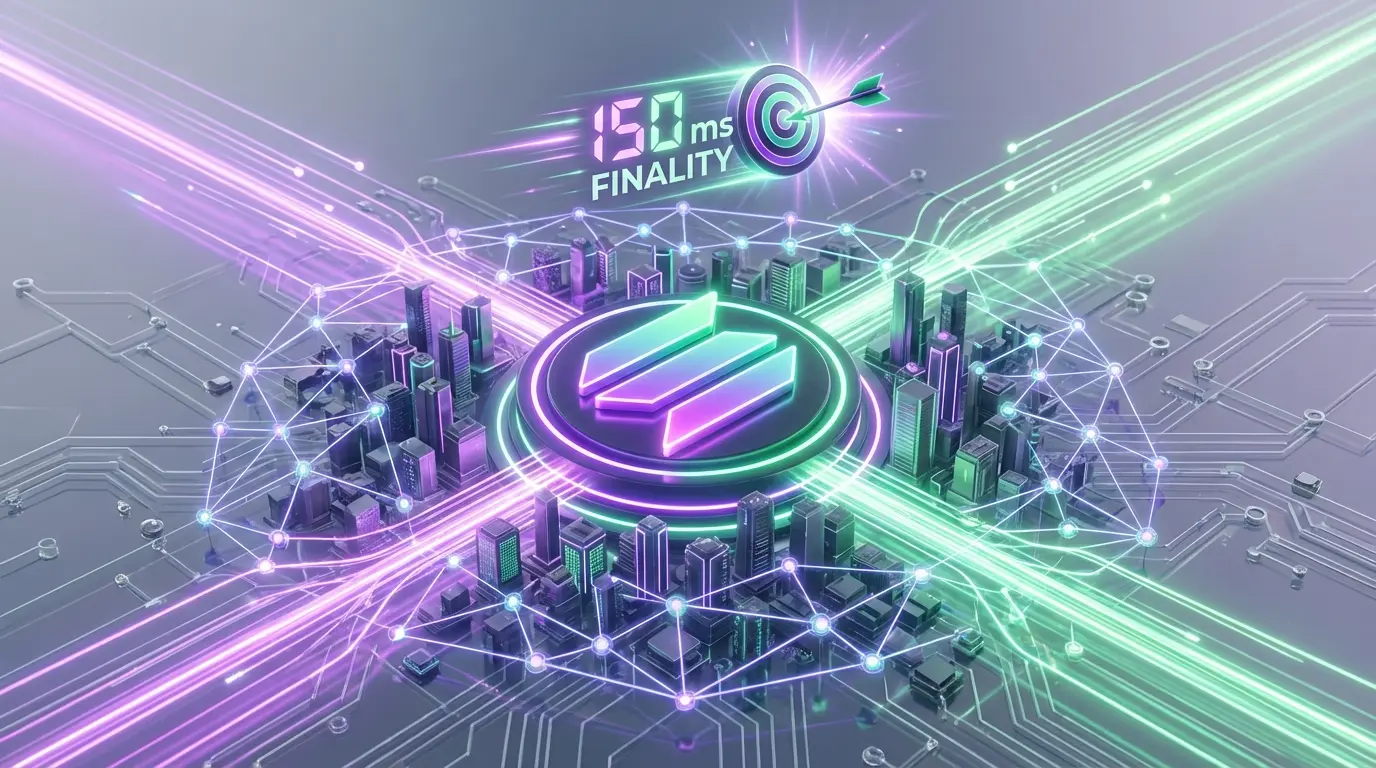
Solana has officially activated its most significant consensus architecture update since the network's inception. The highly anticipated Alpenglow upgrade, which secured an overwhelming 98% approval rating from the global validator set, fundamentally alters how transactions are confirmed, slashing transaction finality to a blistering 150 milliseconds while revolutionizing the network's internal economic structure.
The Dawn of Alpenglow: Redefining Blockchain Speed
For years, Solana has maintained its reputation as one of the fastest Layer-1 blockchains in the digital asset ecosystem. However, the implementation of the Alpenglow upgrade pushes the network's capabilities into an entirely new echelon. By officially deprecating and replacing the original Tower BFT consensus mechanism, Alpenglow reduces transaction finality from an average of 400 milliseconds down to an astonishing 100 to 150 milliseconds.
While a reduction of 250 milliseconds might appear negligible to the casual observer, crossing the 150-millisecond threshold is a monumental achievement in distributed ledger technology. This specific latency metric places Solana's execution and settlement speed in the exact same category as traditional, centralized financial exchanges and global payment processors like Visa and Mastercard. The network can now process, verify, and permanently record global transactions faster than the human blink.
Key Performance Metrics
The Alpenglow upgrade successfully reduces transaction finality to 150ms and reclaims 50% of the network's total throughput capacity by moving validator consensus voting off-chain, effectively doubling usable blockspace for decentralized applications.
High-Frequency Trading and Web3 Gaming Revolution
Transaction finality refers to the precise moment a transaction becomes mathematically irreversible on the blockchain. In the realm of decentralized finance (DeFi), speed is synonymous with capital efficiency. High-frequency trading algorithms and automated market makers (AMMs) require sub-200-millisecond confirmation times to prevent stale pricing, mitigate maximum extractable value (MEV) attacks, and eliminate slippage during volatile market conditions.
Furthermore, the fully on-chain gaming sector stands to be a primary beneficiary of this architectural shift. Modern gaming applications rely on near-instant state changes to ensure player actions—such as moving a character or executing an in-game transaction—register without any perceptible latency. At 150 milliseconds, Solana can now facilitate decentralized applications that perfectly mirror the seamless user experience of centralized Web2 servers. When juxtaposed against Ethereum's 12-minute finality under normal network conditions, Solana's technological moat becomes increasingly apparent.
Bidding Farewell to Tower BFT: A Leap in Consensus Architecture
Prior to the successful deployment of Alpenglow, Solana relied on Tower BFT—a highly customized implementation of Practical Byzantine Fault Tolerance (PBFT) that was deeply integrated with the network's proprietary Proof of History (PoH) cryptographic clock. While Tower BFT served as the robust foundation for the network's initial five years of operation, it harbored structural inefficiencies that scaled poorly as global network activity exploded.
The most glaring bottleneck within the Tower BFT system was its approach to on-chain vote processing. Under the legacy consensus model, every single validator was strictly required to submit on-chain voting transactions for every slot to achieve network consensus. These continuous voting transactions consumed an astounding 50% of Solana's total network throughput. Half of the blockchain's precious blockspace was dedicated entirely to internal network maintenance, artificially restricting the capacity available for actual user transactions, smart contract executions, and decentralized applications.
Alpenglow resolves the network's most critical bottleneck by moving vote aggregation entirely off-chain, effectively doubling the network's usable capacity for decentralized applications without requiring a single hardware upgrade from node operators.
Transforming Validator Economics and Decentralization
Beyond the technical limitations of throughput, Tower BFT placed a heavy financial burden on the network's decentralized infrastructure. Because each consensus vote was processed as a standard on-chain transaction, Solana's approximately 1,700 active validators were forced to pay continuous transaction fees simply to participate in securing the network. Over a standard operational year, these micro-fees accumulated into thousands of dollars in overhead costs per node.
This legacy fee structure disproportionately punished smaller, independent validators. Operators with lower amounts of delegated stake frequently discovered that their mandatory voting costs completely eclipsed their block rewards, forcing them to operate at a net loss. The elimination of on-chain voting fees under the Alpenglow architecture fundamentally rewrites this broken economic model.
By eradicating the fixed operational cost of consensus voting, the financial breakeven threshold for running a Solana validator has plummeted. With network staking yields currently stabilizing in the 6% to 7% APY range, validators can now retain a significantly larger percentage of their gross rewards. This vital economic shift drastically lowers the barrier to entry for new node operators, paving the way for enhanced geographic and entity decentralization across the network.
Institutional Adoption: The Rise of P-Tokens and RWA
While the immediate benefits of Alpenglow are already rippling through the DeFi ecosystem, the Solana Foundation is simultaneously laying the groundwork for massive institutional capital inflows. The ecosystem is currently preparing for the highly anticipated implementation of SIMD-0266, a groundbreaking protocol enhancement scheduled for deployment later in 2026. This proposal introduces the revolutionary "P-token" standard, engineered specifically to satisfy the stringent regulatory and compliance requirements of traditional Wall Street institutions.
Historically, traditional financial institutions and global asset managers have encountered severe friction when attempting to tokenize real-world assets (RWAs) on permissionless public blockchains. Standard token formats, such as Solana's native SPL tokens, lack the inherent, base-layer support required for complex jurisdictional compliance rules. The upcoming P-token standard creates a robust framework for highly programmable tokens that embed sophisticated compliance logic directly into the asset's core architecture.
Under this new institutional standard, a tokenized US Treasury bill, corporate bond, or private equity share could natively enforce Know Your Customer (KYC) and Anti-Money Laundering (AML) requirements. It could autonomously restrict token transfers strictly to approved geographical jurisdictions and implement specific trading windows at the protocol level. This innovation eliminates the need for institutional issuers to rely on external, potentially exploitable smart contracts to enforce regulatory compliance, bridging the gap between decentralized rails and traditional finance.
Market Context: Regulatory Clarity and Price Action
These massive technical and architectural upgrades are materializing against a backdrop of rapidly shifting regulatory dynamics and explosive market sentiment for the SOL token. A landmark legal ruling on March 17 officially confirmed SOL's classification as a digital commodity, firmly placing the asset under the regulatory jurisdiction of the Commodity Futures Trading Commission (CFTC) rather than the Securities and Exchange Commission (SEC). This definitive classification generally subjects trading platforms and institutional issuers to much clearer, lighter regulatory frameworks compared to unregistered securities.
This newfound regulatory clarity, acting in synergy with the network's unparalleled technical upgrades, has directly correlated with a surge in institutional appetite. According to recent comprehensive market reports, spot Solana exchange-traded funds (ETFs) are currently experiencing relentless, steady inflows, with total institutional ETF investments rapidly approaching the $900 million milestone for 2026.
Technical Analysis and Future Outlook
In the broader cryptocurrency market context, SOL is currently navigating a powerful recovery phase. After weathering a significant macroeconomic drawdown that saw the asset retrace from its previous cycle peak of $293 down to a local bottom of $87.23, the native token is currently demonstrating immense relative strength. Armed with the Alpenglow narrative, SOL is aggressively testing key psychological and technical resistance levels just below the crucial $100 mark.
Market analysts and on-chain researchers note that the combination of relentless institutional ETF demand, the accumulation of spot assets by large-scale holders, and the newly unlocked network capacity are creating a perfect storm for a bullish market structure. As the Alpenglow upgrade settles into the mainnet beta environment, the network operates with unprecedented 150-millisecond finality, vastly expanded throughput capacity, and highly optimized validator economics. With the institutional P-token standard firmly on the horizon and ETF inflows accelerating, market participants are closely monitoring how these pristine protocol fundamentals will dictate Solana's trajectory in the coming quarters.