

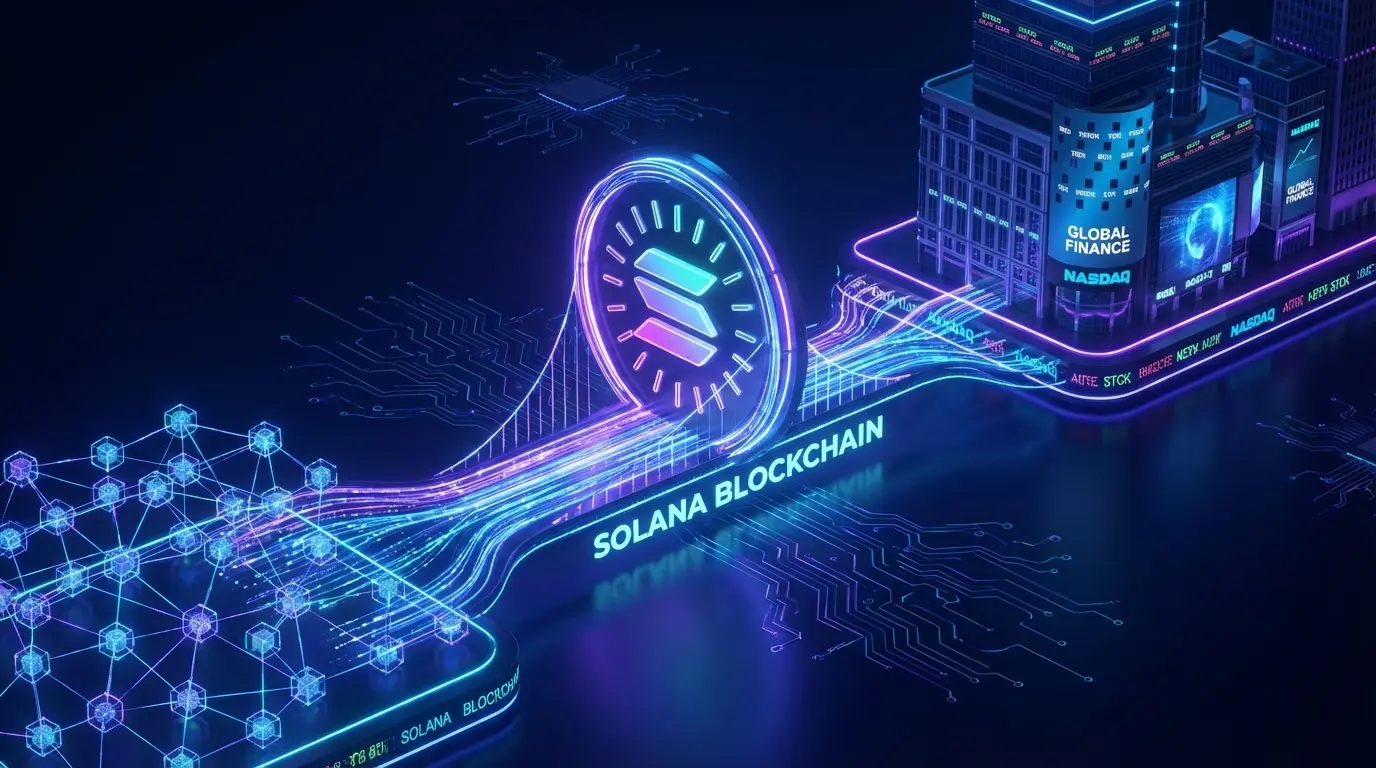
Solana's ascension over the past three years has been largely defined by its raw speed and unparalleled throughput capabilities. However, as the network positions itself to compete with traditional financial behemoths like NASDAQ and SWIFT, ecosystem leaders are arguing that execution quality must become the primary focus.
The Evolution of Solana's Core Philosophy
For years, the rallying cry of the Solana ecosystem has been a simple, highly effective mantra: Increase Bandwidth, Reduce Latency (IBRL). This intense focus on technical performance and hardware optimization helped Solana recover from its $8 token valuation in early 2023 to become a top-three Layer-1 ecosystem. However, as the network matures, the limitations of speed as a standalone metric are becoming apparent.
According to Brian Smith, President of the Jito Foundation, the infrastructure required to support global finance relies heavily on market microstructure and block building, rather than just bandwidth and latency. Speed alone is insufficient for managing modern financial life, especially when dealing with the complex routing, large-scale order matching, and risk management required by institutional capital.
The network now faces two distinct competitive landscapes. First, it must contend with hyper-specialized blockchains tailored for specific markets, such as perpetual futures or stablecoins. Second, and more significantly, Solana's ambition to become the home of global finance means it is competing directly with legacy financial infrastructure, including the Automated Clearing House (ACH), the Chicago Mercantile Exchange (CME), and the SWIFT banking network.
Market Context and Unprecedented Institutional Growth
The discussion surrounding Solana's underlying architecture comes during a period of significant network activity and rigorous market testing. According to recent data from FXEmpire, the native token SOL is currently navigating a high-stakes market battle around the $80 support level, accompanied by a massive 90% spike in trading volume. Despite short-term price volatility, the network's fundamental metrics have demonstrated substantial, sustained growth.
Yahoo Finance reports that Solana ranked first among all blockchains in decentralized exchange (DEX) volume in 2025, clearing more than $3.4 billion. This robust on-chain liquidity has not occurred in a vacuum; it has been accompanied by increasing integration with traditional financial entities that recognize the network's potential to overhaul legacy settlement systems.
Key Institutional Milestones
Major payment processors including Visa, PayPal, and Worldpay are actively building on the Solana network, utilizing its high-throughput infrastructure for treasury management, cross-border remittances, neobanking operations, and instant merchant settlement.
Expanding Public Market Exposure
Furthermore, institutional exposure to the network is rapidly expanding into traditional public markets. Business Insider notes that publicly listed entities, such as Solana Company (NASDAQ: HSDT), have expanded their business models to include digital asset treasuries specifically dedicated to acquiring and holding SOL tokens. This mirrors the corporate treasury strategies previously seen exclusively with Bitcoin.
In the payments sector, real-world utility is also accelerating at a breakneck pace. StraitsX, a prominent Singapore-based financial technology company, reported an astonishing 40x surge in transaction volume for its stablecoin card program between 2024 and 2025, proving that consumer-facing applications on Solana are gaining massive traction.
Solana is no longer just a high-speed blockchain; it is actively positioning itself as the capital market for every asset on earth, demanding a fundamental shift in how we approach structural neutrality and execution quality.
Decoding Block Building and Market Microstructure
To compete at the highest level of global financial infrastructure, Smith emphasizes that Solana must make core changes to its architecture, specifically regarding block building. Block building is the highly complex mechanism that determines which transactions get included in each block, the precise order in which they appear, and under what exact conditions they are executed.
The Role of the Block Builder
While retail users swapping tokens or accessing decentralized finance (DeFi) protocols rarely interact directly with block building, it serves as the foundational market microstructure of the blockchain. A block builder holds immense discretion over transaction timing, ordering, and inclusion. When this discretion is available, it can be exercised in ways that fundamentally impact market dynamics and profitability.
Smith points to recent quantitative analysis conducted across 2.82 million network slots, which found measurable, statistically significant differences in block build times, oracle update positioning, and trading outcomes depending on the specific block builder in charge of that slot. For institutional market makers, a builder who delays releasing block data while controlling transaction ordering can determine whether a crucial price update lands before or after an incoming trade.
These fine-grained distinctions become absolutely critical during severe adverse-selection episodes—tail events characterized by extreme market volatility that ultimately determine whether a decentralized venue is safe and profitable for market makers to provide liquidity on.
The Vertical Integration Dilemma
The current landscape of block building introduces profound structural questions regarding vertical integration within the blockchain ecosystem. When a single entity controls the transaction landing service, the block builder, and a proprietary trading operation simultaneously, structural incentives exist that could negatively impact everyday users and institutional participants alike.
Ensuring Structural Neutrality
Smith notes that if market maker quote updates land at consistently different positions in a block depending on which builder is in control, and an affiliated trading operation benefits from those exact differences, the neutrality of the entire infrastructure can be called into question. While recent on-chain data suggests that at least one such dynamic within the ecosystem has self-corrected due to community pressure, the broader structural question of how to programmatically prevent these situations remains a heavily debated topic among core developers.
Transparency and independently verifiable open-source code are cited as the primary methods for ensuring infrastructure neutrality. Ecosystem leaders emphasize that vague commitments to open-source development in the future simply do not carry the same weight as verifiable open-source code available for public auditing today.
The Road Ahead: Protocol Upgrades and 2027 Vision
The long-term architectural solution for Solana's execution quality involves deep, protocol-level infrastructure changes rather than just social consensus. According to Smith, Solana's technical roadmap includes a massive evolution that would distribute block production across multiple simultaneous validators. This concurrent design aims to completely remove any single actor's ability to maliciously time or sequence transactions advantageously, effectively neutralizing predatory MEV (Maximal Extractable Value) strategies.
Securing Institutional Trust
This monumental architectural shift depends on a next-generation consensus protocol that is currently targeted for deployment in 2027. With full implementation estimated to be twelve to eighteen months away, the network faces a critical interim period where infrastructure operators, validators, and core developers must collaboratively manage network health and enforce strict execution standards.
As major financial institutions continue to explore on-chain settlement and regulated exchanges evaluate Solana as a foundational layer for tokenized real-world assets (RWAs), institutional-grade execution guarantees remain a non-negotiable prerequisite for broader adoption. Sophisticated market participants require crystal-clear rules, absolute structural neutrality, and bounded risks to route their multi-million dollar trading flows effectively. The ecosystem's ability to coordinate around verifiable block-building infrastructure and prioritize execution quality over the next 18 months will undoubtedly determine its capacity to capture permanent market share from legacy financial systems.