
Solana Foundation's new Launch On Solana hub introduces four production-ready developer tools designed to eliminate the blockchain industry's most persistent barriers—from confusing transaction fees to fragmented commerce experiences. Announced October 24, 2025, this strategic initiative prioritizes practical infrastructure over marketing hype.
Introducing Launch on @solana, Kora, and CommerceKit.
— Solana Foundation (@SolanaFndn) October 24, 2025
New open source Solana tools to help you get to market even faster. pic.twitter.com/V8iZ8WHJR8
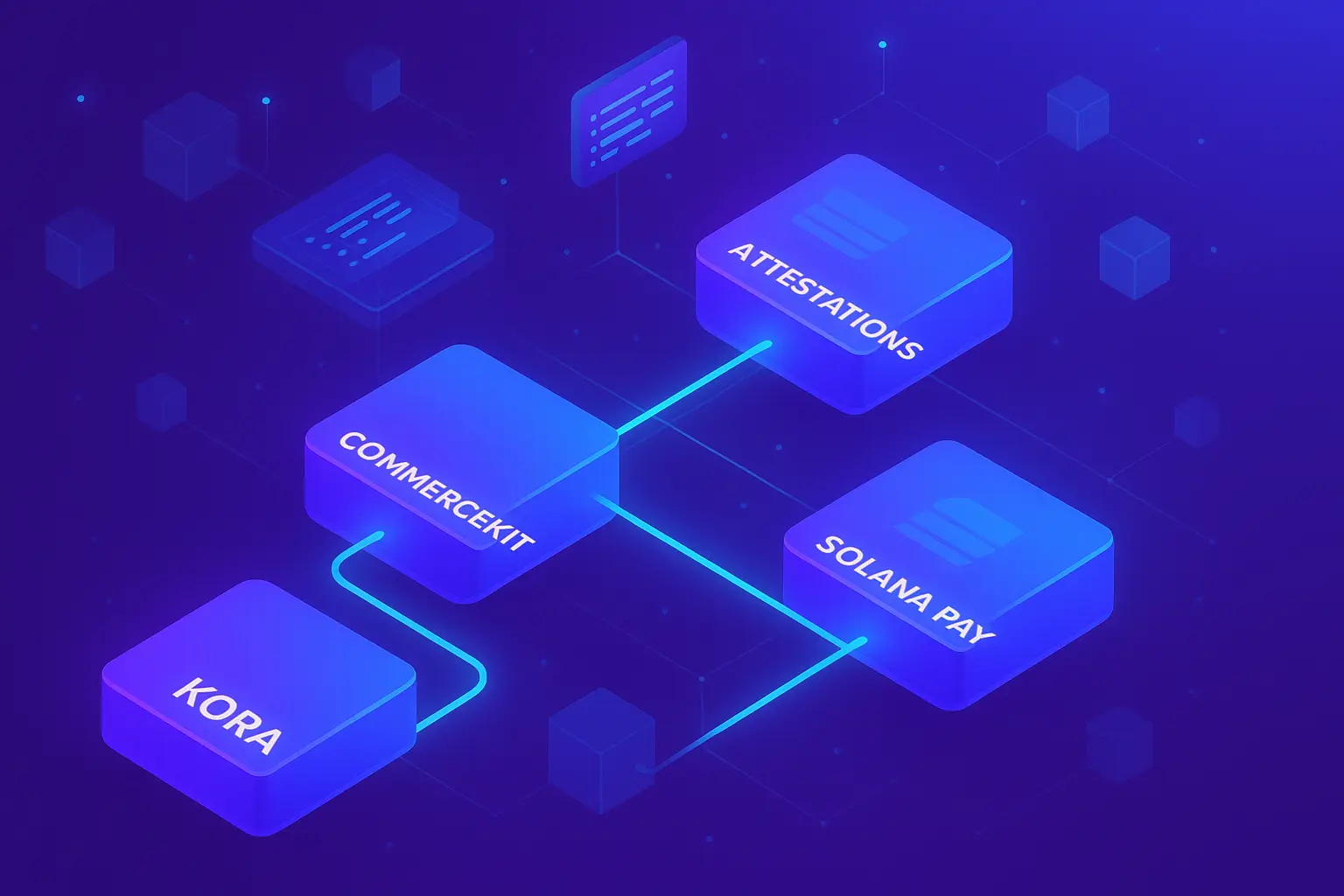
The hub consolidates Kora (fee abstraction), CommerceKit (e-commerce toolkit), Attestations (decentralized identity), and Solana Pay (payment protocol) into a unified platform. With over 106,000 views but limited mainstream media coverage, the announcement signals a deliberate focus on substance over spectacle.
Kora: Eliminating the $3 Barrier That Broke User Experience
Every blockchain developer recognizes the moment: a user holds USDC or another token but cannot complete a transaction because they lack the network's native token for fees. One developer described standing at a coffee shop with USDC earned from freelance work, unable to spend it without first acquiring SOL. This fundamental UX problem has deterred millions of potential users.
How Kora Works
Kora enables users to pay transaction fees in any cryptocurrency they already own—USDC, BONK, or custom tokens—while automatically handling SOL requirements behind the scenes through a paymaster model. Users never touch SOL, yet the network receives payment.
The technical architecture includes a Rust core library for transaction verification, JSON-RPC server for communication, TypeScript SDK for integration, and CLI tool for node operators. Developers can use existing Kora services, run their own nodes, or implement hybrid approaches depending on their needs.
Real-World Applications Beyond Convenience
Fee abstraction unlocks use cases previously impossible on blockchain infrastructure. In emerging markets where crypto exchange access is expensive or restricted, users receiving stablecoin remittances can immediately transact without first acquiring native tokens. Gaming applications achieve truly gasless experiences where microtransactions occur invisibly. DeFi protocols automatically deduct fees from user earnings, enabling set-and-forget yield strategies.
The Solana Foundation explicitly solicited developer feedback to 'break Kora and make it better,' signaling collaborative improvement rather than marketing a finished product.
Within hours of the October 24 launch, technical questions appeared on Solana Stack Exchange as developers began experimenting with the new infrastructure. The community response suggests cautious optimism, though node operator economics—including token price volatility risk and SOL reserve requirements—remain areas requiring validation at scale.
CommerceKit: Competing Directly With Traditional Payment Processors
CommerceKit delivers a complete e-commerce toolkit for building Solana-powered online stores, featuring pre-built smart contracts, token-gating capabilities, revenue splits for collaborations, NFT airdrops for engagement, and on-chain loyalty programs. The business case challenges traditional payment infrastructure directly.
The Economics of Blockchain Commerce
Traditional payment processors charge 2.9% plus $0.30 per transaction with 2-7 day settlement periods and chargeback risk. Solana transactions cost approximately $0.00025, settle in under 400 milliseconds, and are final. For small businesses processing $1 million annually, this translates to $30,000 saved in fees plus immediate fund access for improved cash flow management.
Proven Real-World Success
Boba Guys tea shop chain built a Solana-powered loyalty program that achieved a 67% increase in monthly sales with over 50,000 active users. Solana Mobile uses Solana Pay to avoid credit card fees on hardware sales entirely.
The Shopify integration approved in 2023 makes Solana Pay available to millions of merchants through the official app store. Merchants need only business registration, KYB verification, and a Solana wallet to begin accepting USDC payments. CommerceKit integrates seamlessly with Solana Pay for checkout, Kora for fee abstraction, and Attestations for access control—creating a comprehensive commerce infrastructure.
Trade-Offs and Market Reality
Blockchain commerce eliminates fees and settlement delays but requires customers with crypto knowledge and wallets. Stablecoins like USDC mitigate volatility concerns, yet mainstream adoption remains in early stages. Transaction irreversibility prevents chargebacks—beneficial for merchants but potentially concerning for consumer protection advocates. Many businesses implementing Solana commerce maintain traditional payment options alongside crypto, reducing blended rates while preserving accessibility.
Attestations: Portable Identity Across the Ecosystem
Launching on mainnet in May 2024, Attestations provide what Solana calls the trust layer for internet capital markets. The system enables trusted issuers to create cryptographically signed, verifiable credentials linking off-chain information—KYC checks, accreditation status, membership verification—to users' Solana wallets. These attestations remain portable and reusable across applications without requiring repeated verification processes.
The technical mechanism uses Program Derived Accounts (PDAs) with privacy-preserving design: sensitive data stays off-chain while only signed proofs exist on-chain. Four roles define the ecosystem—issuers create schemas and credentials, authorities manage attestations, holders store references in wallets, and verifiers request presentations for identity workflows.
Demonstrating Speed and Efficiency
At the launch event, Polyflow and Rome demonstrated live KYC verification reducing processing time from 5-10 minutes to under 30 seconds by reusing existing attestations. The founding Solana Identity Group includes Civic (Civic Pass integration), Solid (priority passes with staking), Solana.ID (career verification), and Trusta Labs (AI-powered identity), with additional integrations from Range Security, Sumsub, RNS.ID, Wecan, and Honeycomb Protocol.
Use cases extend far beyond compliance. DAOs can implement reputation systems with portable voting credentials. Token launches can prevent Sybil attacks through verified humanity proofs. Real-world asset platforms can verify accreditation for securities offerings.
For mainstream adoption, this infrastructure matters significantly. Traditional finance requires robust identity and compliance mechanisms. Attestations provide this without recreating centralized databases that blockchain technology promised to eliminate. Financial institutions can satisfy KYC requirements, geographic restrictions, and accreditation verification while users maintain custody of their credentials—addressing a fundamental blocker for institutional DeFi adoption.
Solana Pay: The Payment Rails Connecting Everything
Though Solana Pay launched in February 2022—predating the Launch On Solana hub—its integration into the unified platform reveals strategic positioning. The decentralized, peer-to-peer payment protocol enables instant USDC transactions with near-zero fees, eliminating bank intermediaries, chargebacks, and holding times. The August 2023 Shopify integration marked a watershed moment for accessibility.
Current Adoption Metrics
MonkeDAO, MadLads, Helius, and the Solana official merchandise store process real transactions. Visa announced support for Solana blockchain payments with USDC in September 2023. PayPal integrated PYUSD specifically citing Solana's speed and cost advantages in May 2024.
Technical improvements in 2024-2025 focused on developer experience: single SDK call integration, mobile-first wallet support similar to Apple Pay, compatibility with both self-custodial wallets (Phantom, Solflare) and custodial options (Coinbase), plus enhanced RPC services from QuickNode and Helius. Within the Launch ecosystem, Solana Pay serves as the payment rails connecting all other products—Attestations verify customer eligibility, CommerceKit manages storefront logic, Kora abstracts fees, and Solana Pay executes settlement.
Competitive Positioning: Reshaping the Blockchain Battlefield
Solana's comprehensive developer toolkit positions it distinctively against Ethereum, Base, and Polygon, though success requires flawless execution in a rapidly evolving landscape. The competitive analysis reveals both advantages and persistent challenges facing the ecosystem.
Ethereum's Dominance Versus Solana's Performance
Ethereum maintains overwhelming ecosystem advantages: $92.21 billion TVL versus Solana's $8.9 billion, 6,244 monthly active developers versus Solana's 3,201, and 4,000+ dApps with deeper DeFi liquidity versus 440+ on Solana. The maturity gap extends to tooling, institutional relationships, and first-mover benefits.
However, Solana delivers 170x faster transactions and 100x cheaper fees without Layer-2 complexity. This architecture enables use cases economically impractical on Ethereum—high-frequency DEX trading, micropayments, real-time gaming. Remarkably, 81% of all blockchain DEX transactions now occur on Solana, demonstrating product-market fit for performance-critical applications.
The 'Only Possible On Solana' Narrative
Solana has successfully established OPOS (Only Possible On Solana) narratives that differentiate it from competitors. Jupiter Exchange's all-in-one trading with dollar-cost averaging becomes economically viable only with Solana's fee structure. Pump.fun's memecoin bonding curves with 69K market cap mechanisms work because transaction costs don't eliminate profitability. These aren't theoretical advantages—they're live applications with real users choosing Solana because alternatives don't work.
Developer Experience: Progress and Remaining Friction
Monthly active developer retention increased from 31% to over 50% in 2023—a meaningful shift suggesting that once developers overcome the initial learning curve, they stay engaged. The ecosystem now supports 12+ programming languages beyond Rust, including Solidity (via Neon EVM), Python (Seahorse), and TypeScript, lowering barriers for developers unwilling to learn Rust's complexity.
Tooling parity with Ethereum has largely been achieved. Anchor Framework simplifies Solana development analogously to Hardhat/Foundry for Ethereum. Solana Playground offers browser-based IDE accessibility. Bankrun.js enables fast local testing. Helius and Ironforge provide production infrastructure. The comprehensive SDK ecosystem streamlines frontend integration.
Challenges That Remain
Rust's learning curve still intimidates many developers; only 7% of 5,800 Solidity developers have tried Solana. The account model requires unlearning EVM paradigms. Code coverage tools and debugging capabilities, while improving, lag behind Foundry and other mature EVM tooling. For developers building performance-critical applications, these trade-offs prove worthwhile. For those building applications where performance doesn't matter, Ethereum's familiarity often wins.
The Launch On Solana initiative accelerates onboarding by providing production-ready infrastructure. Developers can integrate Kora fee abstraction, CommerceKit commerce logic, Attestations identity, and Solana Pay payments without building from scratch.
The Path to Mainstream Adoption
Network reliability dramatically improved—from 14 major outages in 2022 to just one in 2024, with 18+ months of 100% uptime achieved in H2 2024-H1 2025. Technical upgrades (QUIC TPUs, stake-weighted quality-of-service, localized fee markets) resolved stability concerns that previously deterred institutions. Yet historical outage records still create hesitation for risk-averse enterprises.
Institutional Adoption Milestones
Franklin Templeton extended its FOBXX money market fund to Solana via the BENJI platform. Fidelity added SOL support. Hong Kong launched its first Solana ETF. Corporate treasuries invested $2 billion in SOL. The Rex-Osprey Solana Staking ETF launched June 2025.
Solana Mobile's strategy represents a unique mainstream on-ramp: 150,000+ Seeker phones shipped with integrated Seed Vault key storage, native Solana dApp Store, and onchain Genesis Token perks. Hardware-blockchain integration creates frictionless experiences impossible on general-purpose devices. Whether hardware wallets integrated into consumer electronics drive adoption or remain niche products will significantly impact Solana's trajectory.
Persistent Barriers Haven't Disappeared
Memecoin reputation—81% of DEX volume trading speculative assets—may repel traditional users seeking stability. High validator hardware requirements (128GB memory, 30TB+ storage) raise centralization questions that institutions care about. Regulatory uncertainty affects all blockchains, but Layer-1 tokens face more scrutiny than Layer-2 solutions. The requirement for users to understand crypto basics, manage wallets, and acquire tokens persists despite UX improvements.
Strategic Bet on Infrastructure Over Hype
The Launch On Solana initiative represents a calculated wager that developer tooling, not token price or marketing campaigns, drives blockchain adoption. By bundling fee abstraction, commerce infrastructure, decentralized identity, and payment protocols into unified open-source tools, Solana created a comprehensive platform for building applications that compete with—not merely replicate—traditional web2 services.
The timing proves deliberate. With 7,600+ new developers joining in 2024, $8.9 billion TVL, 81% DEX transaction dominance, and 18+ months of network stability, Solana's infrastructure can support mainstream applications. The institutional partnerships, hardware integration, and real-world case studies demonstrate viability beyond speculative DeFi.
The competitive positioning is clear: Solana targets performance-critical applications where speed and cost enable business models impossible elsewhere. High-frequency trading, gaming, micropayments, global commerce—these use cases demand infrastructure that Ethereum Layer-2s are only now approaching.
Whether this initiative achieves mainstream adoption depends on factors beyond Solana Foundation's control: regulatory developments, macroeconomic conditions, competing blockchain improvements, and whether developers convert tooling into killer applications. But the strategy proves sound—address the biggest user experience problems, provide production-ready solutions, make integration as simple as possible, and let builders create the use cases that justify blockchain's complexity.
Conclusion: Building the Future of Decentralized Technology
For the crypto ecosystem, Solana's contribution isn't necessarily displacing Ethereum—it's proving that different architectures enable different possibilities. The competitive pressure improves all chains. The developer tooling innovations spread across ecosystems. The real-world applications demonstrate blockchain's utility beyond speculation. This benefits everyone building the future of decentralized technology, regardless of which chain ultimately dominates.
The launch hub is live at launch.solana.com. The tools are open-source. The documentation is comprehensive. Now comes the challenging part: building applications compelling enough to convince mainstream users that blockchain technology solves problems they actually have. With Kora eliminating fee friction, CommerceKit enabling economically viable commerce, Attestations providing portable identity, and Solana Pay delivering instant settlement, the infrastructure exists. The next chapter depends on what developers build with these tools.