

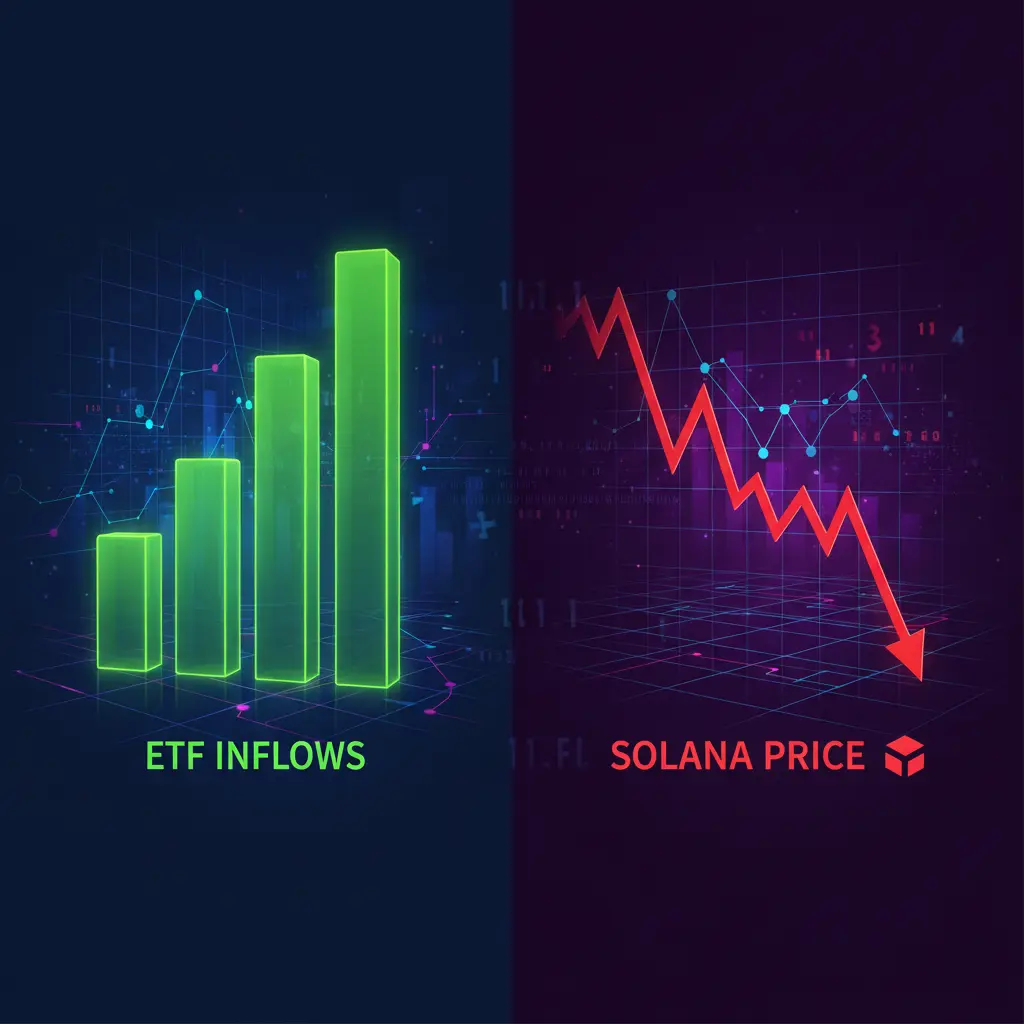
Despite a historic streak of institutional inflows into Solana exchange-traded funds, the asset's price has faced severe bearish pressure, creating a confusing divergence for retail investors.
The Great Decoupling: Inflows vs. Price Action
The cryptocurrency market is currently witnessing a fascinating and somewhat perplexing phenomenon surrounding Solana (SOL). Since the launch of spot Solana ETFs in October, the investment vehicles have demonstrated remarkable resilience and attractiveness to institutional capital. Cumulative inflows have surged to approximately $884.4 million, a figure that, under normal market conditions, would typically correlate with significant bullish price action.
However, the reality on the charts paints a starkly different picture. Instead of rallying, Solana has shed approximately 37.8% of its value since the ETF products went live, currently trading around the $117 mark. This divergence has left many market participants questioning the efficacy of ETFs as price drivers and seeking answers regarding the underlying mechanics causing this suppression.
Market Data Discrepancy
While ETF inflows have been consistent, recording zero weeks of net outflows, the spot price of SOL has decoupled completely, highlighting that institutional accumulation does not always equal immediate price appreciation.
Analyzing the Market Structure
To understand why nearly a billion dollars in inflows hasn't moved the needle, one must look at the broader market structure. The sheer size of the global Solana trading market dwarfs the activity seen within these ETF products. While $884 million is a substantial figure, it pales in comparison to the daily turnover of the asset across centralized and decentralized exchanges.
Simon Shockey, a prominent analyst at Delphi Digital, sheds light on this liquidity mismatch. He points out that the ETF wrapper, while growing, remains a small fraction of the market that actually determines the clearing price. The daily net flows into SOL ETFs are often in the single-digit millions. In contrast, CoinGecko data reveals that Solana's 24-hour trading volume across global venues hovers around $5.3 billion.
The Mechanics of ETF Creation
A critical misunderstanding among retail investors is the mechanism by which ETF inflows translate to spot buying. Unlike direct market buys on an exchange like Binance or Coinbase, ETF flows are primary-market creations. A significant amount of trading occurs within the ETF shares themselves without immediately touching the underlying spot SOL.
Authorized participants (APs) responsible for managing the liquidity of these funds have various tools at their disposal. They can source liquidity over extended periods, utilize existing inventory, or hedge their positions using derivatives. This means that a dollar flowing into an ETF does not necessarily result in an immediate dollar of buying pressure on the spot market, diluting the short-term price impact of these institutional inflows.
The Dominance of Derivatives
While ETFs represent the long-term institutional view, the short-term price action of Solana is currently being dictated by the derivatives market. The leverage, funding rates, and liquidation cascades present in perpetual futures markets can easily overwhelm the steady but modest buying pressure from ETFs.
The ETF wrapper is still small versus the market that actually determines the clearing price – especially perpetuals – where leverage, funding, and liquidations can overwhelm a steady but modest ETF bid.
Recent data underscores the volatility introduced by these leveraged markets. In a single 24-hour period, approximately $29.8 million worth of long positions were liquidated. The aggressive trading on decentralized perpetual exchanges, such as Hyperliquid, generated $430 million in volume for the token in just one day—significantly outpacing the activity seen in the ETF sector.
The FTX Estate Supply Overhang
Beyond market structure and derivatives, a tangible supply-side issue continues to weigh heavily on investor sentiment: the FTX estate. The bankruptcy proceedings of the fallen exchange have resulted in a massive unlocking of Solana tokens, creating a persistent narrative of selling pressure.
In 2024, bankruptcy administrators liquidated roughly two-thirds of a $2.6 billion stash of Solana tokens. These assets were sold to institutional entities, including Galaxy Trading and Neptune Digital, at a significantly discounted cost basis of roughly $64 per token. While these tokens are subject to vesting schedules, the psychological impact of this supply overhang cannot be overstated.
Vesting Schedules and Market Psychology
Neptune Digital, for instance, saw 20% of its acquired allocation unlock in March 2025, with the remainder scheduled to unlock monthly through 2028. Analysts note that while an unlock event does not guarantee an immediate sell-off, the anticipation of potential distribution acts as a cap on rallies. Traders often front-run these events or hedge their positions, creating a self-fulfilling prophecy of price suppression.
Institutional Integration Amidst Volatility
Despite the bearish price action, the fundamental adoption of the Solana network continues to accelerate. The ecosystem is seeing deeper integration with traditional financial products, signaling that the long-term thesis for the network remains intact regardless of current valuations.
WisdomTree, a global asset manager with over $100 billion in AUM, recently launched its full suite of tokenized fund products directly on the Solana blockchain. This allows users to access tokenized funds on-chain, leveraging Solana's high throughput and low latency. This move validates the network's technical capabilities for high-frequency financial operations, even as the token price struggles to find a floor.
Broader Market Context and Outlook
It is also crucial to view Solana's performance within the context of the broader cryptocurrency market correction. Bitcoin has recently dipped below key support levels, dragging the entire altcoin market down with it. Solana's 6.68% intraday drop is severe, but it mirrors the risk-off sentiment pervading the global financial landscape.
Furthermore, regulatory and macroeconomic factors continue to influence capital flows. With reports of increased illicit activity involving cryptocurrency in 2025 and shifting regulatory landscapes in major economies, institutional capital remains cautious. However, the sustained inflows into ETFs suggest that smart money views these price dips as accumulation opportunities rather than reasons to exit.
Conclusion
The decoupling of Solana's price from its ETF inflows serves as a potent reminder of the complexities of crypto market structure. While institutional adoption is a bullish long-term indicator, short-term price action is currently dominated by derivatives volume, supply overhangs from the FTX estate, and broader macroeconomic weakness. For investors, the key takeaway is patience: the infrastructure for the next leg up is being built, even if the price has yet to reflect the growing institutional foundation.