

Solana (SOL) has transitioned from a clean upward trend into a phase of disorderly repricing, triggered by a massive leverage flush across the crypto market despite strengthening on-chain fundamentals.
The Mechanics of the Crash: A Leverage Wipeout
The cryptocurrency market has experienced a severe contraction over the weekend, driven primarily by forced deleveraging rather than a fundamental deterioration of the underlying technology. Solana, often viewed as a high-beta asset relative to Bitcoin, has taken a significant hit, toggling between critical price zones as traders scramble to find a floor.
Data indicates that approximately $974 million in futures positions were liquidated across the broader crypto market in a single 24-hour window. This cascade of margin calls knocked out more than 240,000 traders, creating a domino effect that pushed prices lower regardless of the asset's utility or adoption metrics. While Ether and Bitcoin absorbed the largest nominal hits, Solana saw over $45 million in open interest wiped out almost instantly.
Liquidation Impact
The selling pressure was mechanical and one-sided. Almost all activity represented long liquidations, indicating that traders who had spent weeks buying the dip were finally forced to capitulate, leaving no immediate buyers to absorb the supply shock.
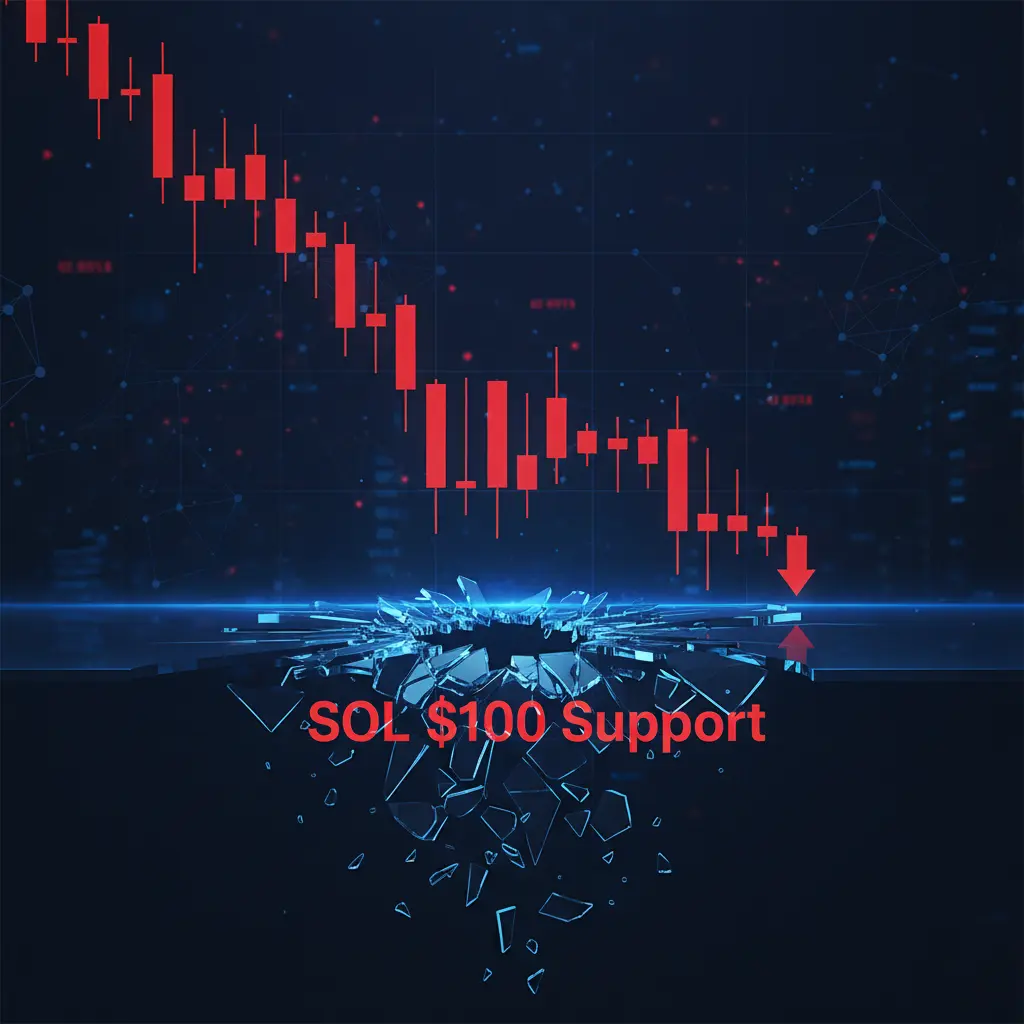
This event underscores a critical market dynamic: the drop was not caused by a sudden loss of faith in the Solana ecosystem, but rather by structurally crowded positioning being flushed out during a period of thin weekend liquidity. When the trading range finally broke, the lack of immediate bid support resulted in a rapid price descent, pushing SOL toward the $103 mark.
Technical Analysis: The Bearish Turn
From a technical perspective, the chart structure for Solana has deteriorated significantly. The asset is currently pinned below its 50-day moving average, which sits roughly at $143, acting as a formidable resistance cap. Furthermore, price action is occurring below the longer-term 200-day moving average, confirming a structural downtrend.
The market is currently treating the previous rally to $150 as a "line in the sand." As long as SOL trades below this pivot point, the recent upside moves are viewed as exhausted. The Relative Strength Index (RSI) is hovering near 40.8, a level that reflects strong downside momentum without yet reaching the classic "oversold" territory that often signals a capitulation bottom. This suggests that while the intensity of the sell-off may be easing, sellers remain in control.
The structure is simple and unforgiving: hold the $100–$105 belt and this is still a deep correction inside a bigger bullish story; lose that belt with real volume and long-only money will start to question the entire last leg of the Solana move.
Current support zones are clearly defined but fragile. TradingView data highlights a near-term defense area between $115 and $120, with a secondary, more critical support line around $105. If these levels fail to hold, the market could see a retest of double-digit prices, fundamentally altering the medium-term outlook for the token.
The Fundamental Divergence: Network Health vs. Price Action
Despite the bearish price action, the underlying health of the Solana network paints a contradictory picture. Unlike "ghost chains" that see activity vanish during bear markets, Solana is behaving like a thriving, high-throughput economy. Weekly active addresses have surged to approximately 27.1 million, representing a 56% week-on-week increase. This is not merely speculative noise; it represents genuine user growth and network utilization.
Furthermore, the staking metrics suggest high conviction among long-term holders. Approximately 70% of the circulating SOL supply is staked, indicating that a vast majority of investors are locked in for yield and long-term exposure rather than looking for a quick exit. This high staking ratio reduces the available floating supply, which, in theory, should support prices—however, in a liquidity crisis, it also means that price discovery is driven by a smaller portion of liquid tokens.
Institutional Adoption Continues Quietly
While retail traders panic, institutional infrastructure continues to build on Solana. The native USD1 stablecoin has crossed a $5 billion market cap, providing deep liquidity for decentralized finance (DeFi) applications. Additionally, financial heavyweights like WisdomTree have integrated over $159 billion in fund infrastructure onto the Solana blockchain, allowing regulated money market funds to settle natively on-chain.
This institutional footprint is a vital signal. It demonstrates that traditional finance views Solana as a settlement layer for real-world assets, regardless of short-term volatility in the SOL token price. While this adoption does not immunize the token from macro-driven drawdowns, it raises the floor of long-term relevance compared to competitors driven purely by speculation.
Navigating the Noise: Meme Coins and Market Sentiment
Amidst this correction, the ecosystem continues to be noisy with speculative fervor. New meme coin launches, such as PATOS and PEPETO, continue to attract attention with promises of astronomical returns. While these projects demonstrate the network's ability to handle high-volume speculative traffic, they also contribute to the volatility and "casino" perception of the chain.
Investors should be wary of anchoring their thesis on these high-risk assets. While a meme coin boom can drive short-term fees and burns, it does not constitute a sustainable value driver for the SOL token in the same way that institutional settlement and stablecoin liquidity do. The divergence between the serious infrastructure being built and the speculative mania on the periphery remains a defining characteristic of the current Solana landscape.
Outlook: The Path Forward
The immediate future for Solana hangs in the balance of the $100–$105 support zone. The broader crypto backdrop remains hostile, with the Fear & Greed Index sitting firmly in "fear" territory at 34. This sentiment suppresses the appetite for leveraged bets, meaning a V-shaped recovery is less likely without a significant macro catalyst.
For the bullish case to resume, SOL needs to reclaim the $135–$143 range and hold it, proving that buyers have regained control. Until then, every rally is likely to be met with selling pressure. However, for investors with a long-term horizon, the disconnect between the crashing price and the soaring network usage may present a strategic accumulation opportunity, provided the critical $100 support level remains intact.