

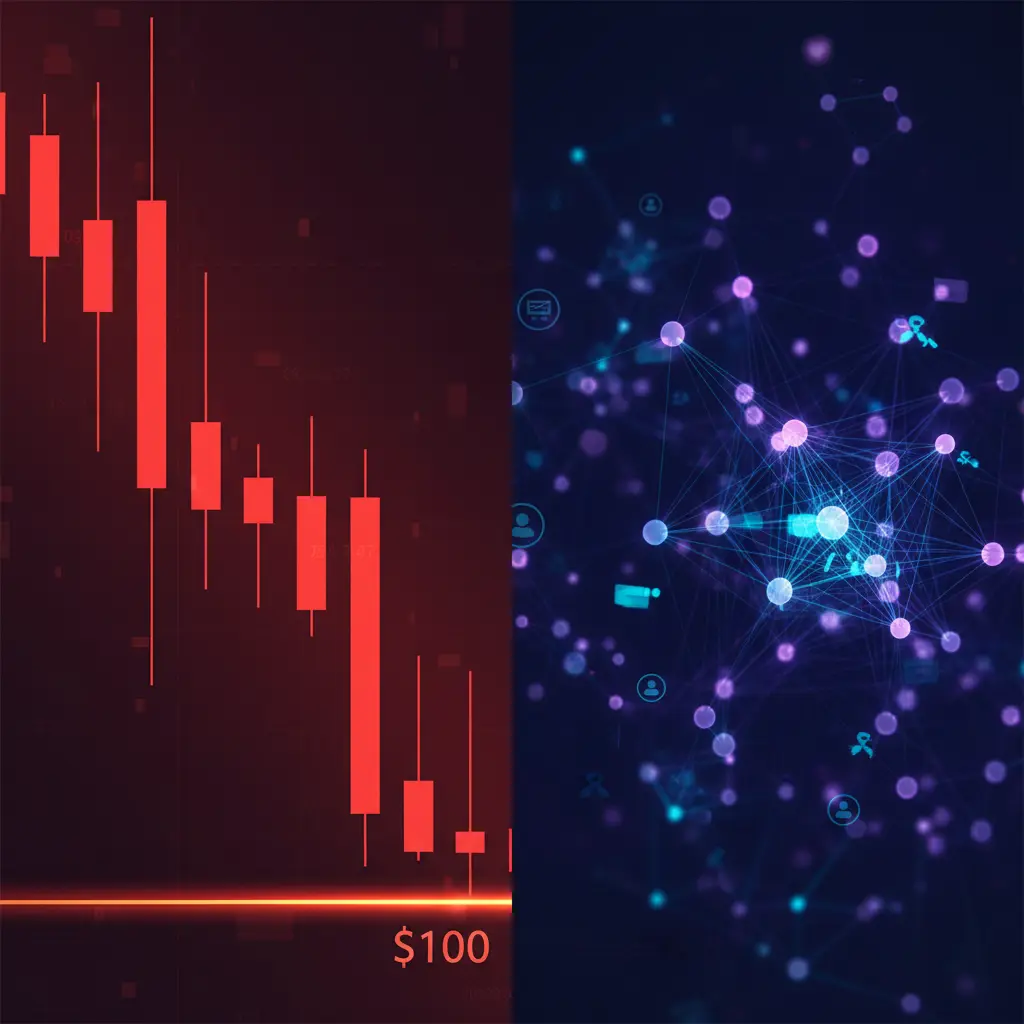
Solana (SOL) is facing a critical market test as prices retreat toward the psychological $100 support level, creating a stark divergence between bearish price action and explosive on-chain growth.
The Great Divergence: Price vs. Utility
The cryptocurrency market is currently witnessing a fascinating and somewhat perplexing phenomenon within the Solana ecosystem. While the token price struggles to gain momentum, underlying network fundamentals are painting a picture of robust health and adoption. According to the latest market data, Solana has retraced significantly after a firm rejection at the $150 supply zone, a level that bulls have unsuccessfully attempted to reclaim since mid-November.
This price suppression has driven the asset's valuation down to levels not seen since April 2025. However, this bearish price action stands in direct contrast to the network's utilization rates. Data from on-chain analytics firm Nansen reveals a thriving ecosystem, with active addresses on the Solana blockchain doubling to over 5 million in January 2026 alone.
Critical Market Insight
While SOL price is down over 30% from recent highs, network activity has surged by 100% month-over-month. This divergence often signals a dislocation between speculative trading and fundamental value accumulation.
This surge in activity is primarily attributed to the decentralized finance (DeFi) sector and decentralized exchanges (DEXs), suggesting that users are actively transacting, trading, and utilizing applications built on Solana, even as the native token's price suffers. This scenario presents a classic value investor's dilemma: is the market wrong, or is the on-chain activity failing to capture value for the token holder?
Technical Analysis: The Bearish Structure
From a technical perspective, the charts are issuing caution to short-term traders. The rejection at the $252.9 level—which aligns perfectly with the 78.6% Fibonacci retracement—was a pivotal moment that confirmed a bearish shift in market structure. Analysts are now pointing to the April 2025 swing low of $95 as the "line in the sand" for the bulls.
Indicators Signaling Oversold Conditions
Detailed technical analysis reveals that the selling pressure has been intense and perhaps overextended. The Relative Strength Index (RSI) on the daily chart has plunged into deep oversold territory with a reading of 22. Typically, an RSI below 30 indicates that an asset has been sold too aggressively and may be due for a relief bounce or consolidation.
However, momentum indicators like On-Balance Volume (OBV) paint a bleaker picture, dropping to new multi-month lows. This suggests that the price decline is supported by significant volume, indicating institutional distribution rather than just retail panic selling.
Key Support and Resistance Levels
Traders are currently mapping out several critical zones. The immediate resistance lies at the local supply zones of $120 and $140. If the price can reclaim these levels, it would invalidate the immediate bearish thesis. However, the downside risks are prominent.
If the $95 support level fails to hold, we are looking at a potential liquidity cascade down to $64 and potentially $47.9. The market is currently in a 'show me' state regarding demand.
The correlation with Bitcoin remains a significant factor. Analysts warn that if Bitcoin fails to hold the $74,000 level, it could act as a catalyst for a broader altcoin capitulation, dragging Solana down to the lower targets mentioned above.
Macroeconomic Headwinds and Tech Correlation
Solana's recent price action cannot be viewed in a vacuum. The asset has historically shown a high correlation with the technology sector, often moving in tandem with high-growth tech stocks and AI-related equities. The current correction in SOL coincides with a broader risk-off sentiment in global markets.
Investors are grappling with macroeconomic concerns, specifically regarding the sustainability of revenue in the Artificial Intelligence sector and recent corporate layoffs. As forecasts for tech earnings are revised downward, high-beta assets like Solana are often the first to experience capital flight. The narrative that Solana is the "NASDAQ of Blockchains" cuts both ways; it benefits during tech booms but suffers acutely during sector rotations and corrections.
Long-Term Outlook: The Bullish Case
Despite the gloomy short-term technicals, the long-term investment thesis for Solana remains heavily debated but optimistically modeled by major institutions. While prediction markets like Kalshi are currently pricing in low probabilities for near-term rallies to $300 or $450, institutional researchers are looking much further ahead.
VanEck's $3,200 Projection
Investment management firm VanEck has published research outlining a scenario where SOL could reach a staggering $3,200 by 2029. This model is contingent on Solana capturing a significant market share of global financial transactions and successfully monetizing its high throughput capabilities. This projection highlights the massive disconnect between day-to-day price fluctuations and multi-year adoption curves.
For long-term holders, the current price retreat might represent a dislocation between price and value. If the network continues to onboard users at the rate seen in January 2026—5 million active addresses—the fundamental value proposition of the network theoretically increases, regardless of the current speculative premium being washed out of the market.
The Path Forward
As Solana approaches the critical $95-$100 zone, the market is at an inflection point. The bulls need to step in and defend this level with significant volume to prevent a structural breakdown to 2024 levels. Conversely, bears are looking for a confirmed close below $95 to aggressively short the asset down to the $60 range.
For the average investor, the key metric to watch remains the disparity between price and usage. History in crypto markets has shown that while price leads sentiment, network activity eventually leads price. Whether this realignment happens at $100 or $50 remains the primary question for the remainder of Q1.