

Credit card-sized, NFC-enabled, battery-free: Solflare's tap-to-sign wallet challenges the $100+ hardware wallet status quo.
At Solana Breakpoint 2025, Solflare co-CEO Philip Dragoslavich unveiled Solflare Shield—a hardware wallet so radically simplified it fits the friction of crypto security into something the size of a credit card with no screen, no cables, no battery, and no Bluetooth. Starting at just $49, Shield represents a fundamental reimagining of what hardware wallets should be: mobile-first, accessible, and designed for everyday use rather than vault-like storage.
The announcement came with immediate availability—all Breakpoint attendees received free Shield wallets, and shipping begins February 2026 for pre-orders that opened December 4, 2025. For a market dominated by $100-200 devices built around screens and buttons, Solflare's approach feels almost heretical: strip away everything except what actually matters for security.
The Problem: Hardware Wallets Are Built for the Wrong Use Case
Traditional hardware wallets—Ledger, Trezor, Coldcard—were designed around a specific mental model: your crypto is a vault, and accessing it should feel ceremonial. This made sense in 2014 when Bitcoin was primarily a store of value and transactions were infrequent.
But Solana's ecosystem tells a different story:
- High-frequency DeFi: Users stake, swap, lend, and farm daily
- Mobile-native culture: Most Solana activity happens on phones, not desktops
- NFT and gaming: Signing dozens of transactions per session is normal
- Social and payments: Solana wallets are becoming super-apps for everyday finance
The current hardware wallet paradigm breaks down completely:
- The Desktop Problem: Most hardware wallets require a desktop computer for setup and use. Solana users live on mobile.
- The Cable Problem: USB connections create friction. Pull out your laptop, find the cable, plug in the device, navigate menus—this works for quarterly portfolio reviews but fails for daily DeFi.
- The Battery Problem: Bluetooth-enabled mobile wallets need charging. Dead battery means locked out of your funds at the worst possible moment.
- The Complexity Problem: Multi-step verification, screen navigation, firmware updates—all create failure points and user friction.
- The Cost Problem: $100-200 price points position hardware wallets as luxury security for whales, not essential infrastructure for all users.
Solflare Shield attacks every single one of these problems.
How Shield Works: NFC + Secure Element = Tap to Sign
Shield's core innovation is radical simplification through NFC technology and tight integration with Solflare's mobile app.
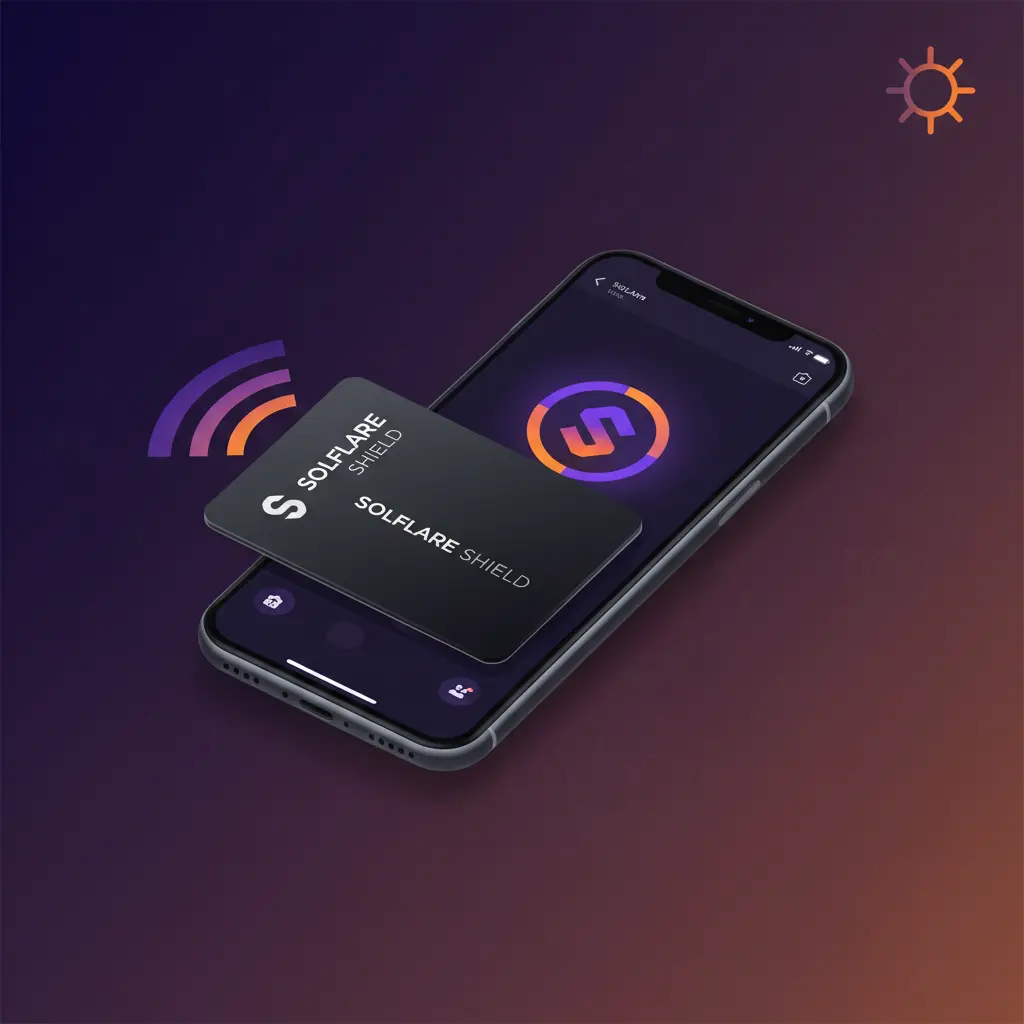
The Hardware Architecture
- Form Factor: Credit card-sized (85.6mm x 54mm x 0.8mm), thin enough for any wallet
- Secure Element: EAL6+ certified chip stores private keys permanently offline
- Communication: NFC only—no USB, no Bluetooth, no WiFi, no cables
- Power: Entirely passive, powered by NFC field from your phone during use
- Durability: 25-year warranty, no moving parts, no battery degradation
The EAL6+ certification deserves emphasis—this is one of the highest security standards in the industry, used for high-security government and financial applications. The same level Ledger and Trezor use, but without their bulk and complexity.
The User Experience
Setup (Under 60 Seconds):
- Download Solflare mobile app
- Tap Shield to phone (NFC pairs instantly)
- Follow on-screen guide to generate and backup recovery phrase
- Set PIN or biometric authentication
- Done
Daily Use:
- Open Solflare app, initiate transaction
- Tap Shield to phone when prompted
- Authenticate with PIN or biometric
- Transaction signed and broadcast
No cables. No charging. No button presses on the device itself. Just tap and authenticate.
Three Variants: From Minimalist to Custom Art
Solflare recognizes that hardware wallets are personal objects people carry daily. Shield comes in three variants:
Shield Origin ($49)
- Matte black minimalist design
- Maximum protection at entry-level price
- Perfect for security-focused users who don't care about aesthetics
- Launch promotion: Duo pack (2 wallets) for $49 (through December 21)
Shield Signature ($59)
- Featured designs from Solana artists and creators
- Limited-edition artwork drops
- Same security, more personality
- Fresh designs arriving regularly
Shield Unique ($59-79, normally $79)
- Fully customizable: upload your own design
- NFT artwork, personal photos, brand logos—anything
- Each card individually manufactured (no mass production)
- One-of-one hardware wallet
- Launch promotion: $59 (through December 21)
This customization angle is brilliant product strategy. Traditional hardware wallets look like utilitarian tech devices. Shield can be a fashion statement, a collectible, or a brand artifact—all while providing identical security to more expensive competitors.
Why This Design Only Works on Solana
Shield's mobile-first, high-frequency signing model requires blockchain characteristics Solana uniquely provides:
- Sub-Second Finality: NFC signing flow needs near-instant transaction confirmation for smooth UX. Waiting 10+ minutes (Bitcoin) or even 12+ seconds (Ethereum) between tap and settlement breaks the experience.
- Low Transaction Costs: If every DeFi interaction costs $1-50 in fees (Ethereum L1), users minimize transactions. Solana's sub-cent fees enable high-frequency signing without economic penalty.
- Mobile-Native Ecosystem: Solana's culture developed around mobile wallets (Phantom, Solflare) and mobile dApps. Users expect phone-based interactions.
The Economics: How Is Shield So Cheap?
$49 for EAL6+ hardware seems impossible when Ledger Nano X costs $149. Solflare co-CEO Filip Dragoslavic explained the economics:
Most hardware wallets are built to work with any wallet software. This generality requires screens, buttons, and complex firmware. Shield eliminates these costs by being purpose-built for Solflare.
Solflare controls both the mobile wallet and the hardware device. They can optimize the entire experience as a unified product rather than building a generic device hoping third parties integrate well. This vertical integration enables cost optimization impossible for general-purpose products.
Security Considerations and Risks
Shield's simplicity raises legitimate security questions:
No Screen = Blind Signing?
Traditional hardware wallets display transaction details on-device screens so users can verify what they're signing without trusting the computer. Shield displays transaction details in the Solflare mobile app. You're trusting your phone isn't compromised. However, most users don't carefully verify on-device screens anyway—they trust their wallet software. Shield makes this trust relationship explicit.
NFC Risks?
Can Shield be skimmed? Protection relies on the PIN/biometric requirement for every signature. The NFC range is extremely short (under 5cm), and no value is stored on the card itself—only signing capability. A thief would need your Shield, your phone, and your PIN.
Launch Promotions and Pricing
Standard Pricing (after December 21, 2025):
Shield Origin: $49 | Shield Signature: $59 | Shield Unique: $79
Launch Pricing (December 3-21, 2025):
Shield Origin Duo Pack: $49 (two wallets)
Shield Unique: $59 (25% off)
Shield Signature: $59 (unchanged)
Conclusion: Rethinking Hardware Wallets
At $49 with tap-to-sign NFC, Shield isn't incrementally improving hardware wallets—it's asking whether screens, buttons, cables, and batteries were necessary in the first place. For Solana's mobile-native ecosystem, the answer appears to be "no."
If Shield achieves meaningful adoption, it validates a crucial thesis: crypto security tools should adapt to user behavior, not force users to adapt to tools designed for a different era.