
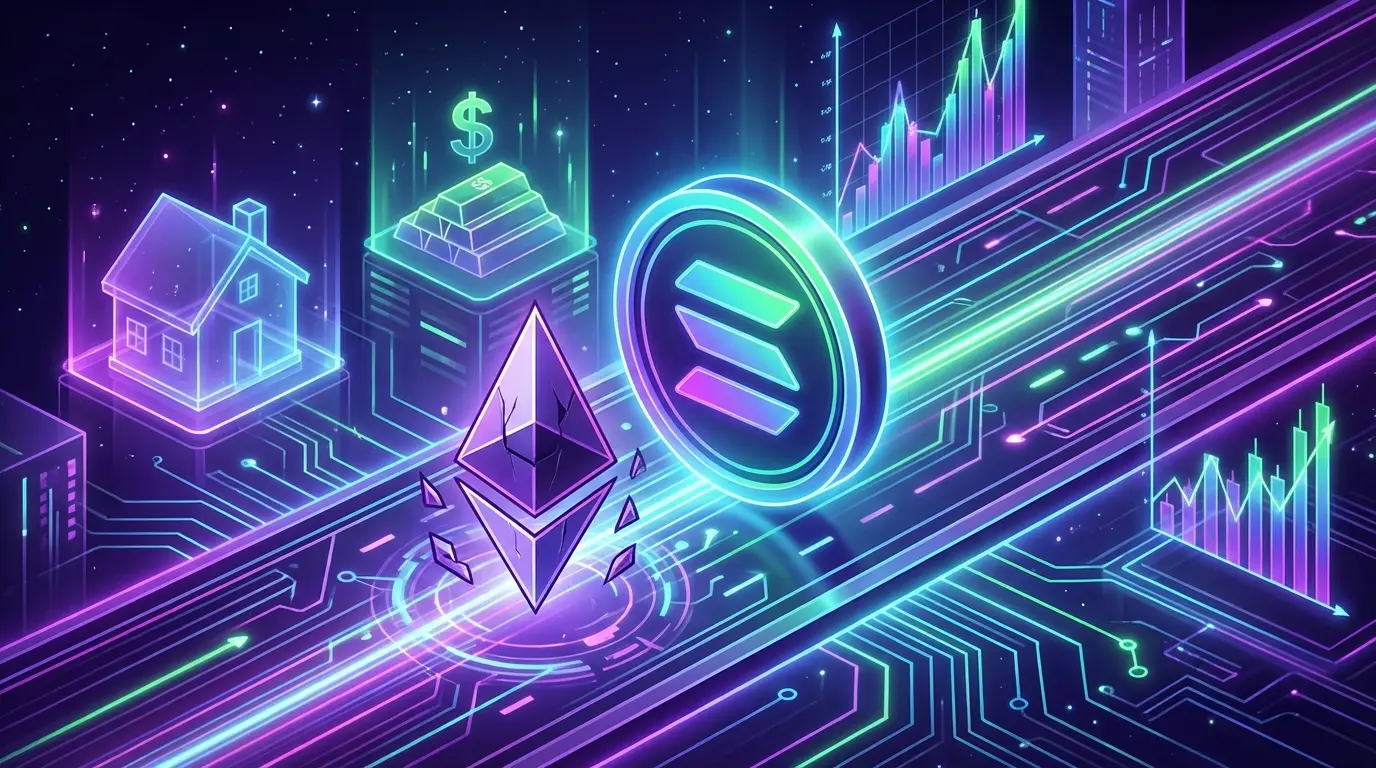
The blockchain tokenization sector has officially reached a monumental milestone, with the Solana network surpassing Ethereum in the total number of wallets holding tokenized real-world assets (RWAs). According to comprehensive data from the RWA analytics platform RWA.xyz, Solana is now the first network to eclipse Ethereum in this highly specific and critical user adoption metric. This paradigm shift highlights the rapid expansion of the Solana ecosystem as tokenized assets become an increasingly prominent segment of the global digital asset infrastructure.
The Evolution of Real-World Assets on the Blockchain
Real-world assets refer to traditional financial instruments or physical objects that have been systematically tokenized and issued on decentralized blockchain networks. This rapidly growing category includes a diverse array of assets such as banked treasury bonds, consumer credit, commodities, real estate, publicly traded stocks, and other conventional financial instruments. By bringing these historically illiquid or heavily intermediated assets on-chain, decentralized protocols aim to significantly increase market liquidity, dramatically improve settlement times, and broaden access to global financial markets for participants of all sizes.
The concept of tokenization is not entirely new, but the execution has reached a tipping point. For years, the traditional financial sector has debated the merits of distributed ledger technology. Now, we are seeing the theoretical applications transform into highly functional, billion-dollar ecosystems. The ability to fractionalize a piece of commercial real estate or a government treasury bill and trade it globally 24/7 without the need for traditional brokerage clearinghouses is revolutionizing how capital flows across borders.
Retail Democratization
The shift in wallet demographics indicates that tokenized assets are no longer just tools for institutional players. Retail investors are increasingly leveraging blockchain networks to gain exposure to traditional financial instruments that previously required high minimum investments.
RWA Holder Metrics: Solana's Accessibility Advantage
Recent data aggregations from the analytics platform RWA.xyz reveal a fascinating trend: the number of individual wallets containing tokenized assets on Solana has steadily edged past the total on the Ethereum mainnet. While the margin between the two competing networks remains relatively slim at present, the milestone is highly indicative of a broader shift in the demographics of participants entering the RWA market.
The unprecedented expansion of Solana in this specific sector is primarily driven by network accessibility and economic efficiency. The sub-cent transaction costs charged by the Solana network, combined with its high-throughput execution capabilities, allow retail investors to seamlessly interact with tokenized assets without incurring the prohibitive gas fees often associated with other Layer-1 blockchains, particularly Ethereum during periods of high network congestion.
The Power of Sub-Cent Transactions
Consequently, retail participation in blockchain-based financial products has expanded significantly on the network. Smaller investors can now dynamically allocate capital to tokenized commodities, yield-bearing stablecoins, and tokenized US treasuries without having their potential returns completely eroded by network transaction fees. This economic reality has created a fertile ground for decentralized applications (dApps) focused on micro-investing and retail-facing RWA platforms.
When a retail investor wants to purchase fifty dollars worth of a tokenized treasury bond, a transaction fee of ten to twenty dollars on a congested network renders the investment mathematically unviable. Solana's architecture completely removes this friction, enabling micro-transactions and high-frequency trading of real-world assets that were previously impossible on legacy blockchain layers.
Network Value, Stablecoins, and Ecosystem Growth
Beyond the sheer number of individual holders, the total value of the RWA sector on the Solana blockchain has also seen substantial and sustained growth over the past year. According to recent ecosystem data, tokenized real-world assets on the Solana network have now exceeded a staggering $1.7 billion in total value. This sprawling ecosystem currently encompasses hundreds of distinct RWA projects and assets, reflecting a rapidly broadening base of financial products available to everyday users and institutional participants alike.
The Fireblocks Integration
Furthermore, the network's underlying infrastructure is increasingly being utilized for enterprise-level operations alongside its popular retail applications. Solana has successfully integrated with premier digital asset infrastructure providers like Fireblocks to deliver secure enterprise treasury operations. This critical integration combines Solana's high-throughput blockchain performance with the institutional-grade security required by major financial entities.
The convergence of sub-cent transaction fees and institutional-grade security infrastructure is creating a bifurcated adoption curve, positioning high-throughput networks as the primary settlement layer for high-frequency retail tokenization.
This robust infrastructure development aligns perfectly with broader network growth metrics. Recent industry reports indicate that Solana's network stablecoin volume has reached a record-breaking $650 billion. This massive reservoir of stablecoin liquidity is absolutely essential for the RWA sector, as it further supports the deep liquidity and instant settlement capabilities required to maintain a highly functional and robust tokenized asset ecosystem.
Ethereum's Enduring Position in Total Value Locked
Although Solana now proudly leads in the total number of individual RWA holders, it is crucial to note that Ethereum continues to heavily dominate the sector in terms of total asset value. Ethereum currently hosts the vast majority of the largest, most heavily capitalized institutional tokenization efforts in the entire digital asset space.
The Institutional Comfort Zone
This enduring dominance is widely attributed to Ethereum's highly developed infrastructure, its extensive, battle-tested track record of network security, and the deep familiarity that global financial regulators and compliance officers have with its blockchain architecture. Large asset managers, multinational banks, and traditional financial institutions continue to deploy their flagship blockchain-based funds and tokenized treasury products primarily on the Ethereum network.
This fascinating dynamic creates a distinct and highly visible contrast between the two dominant ecosystems: Ethereum maintains the lion's share of high-value, strictly regulated institutional products, while Solana is successfully attracting a rapidly growing demographic of retail users seeking frictionless, low-cost access to tokenized traditional assets. Both networks are proving vital, but they are servicing fundamentally different segments of the market.
Market Context: SOL Price Action and Technical Analysis
The explosive growth in Solana's RWA sector occurs alongside highly notable activity in the network's native token market. According to recent Coinbase market data, Solana (SOL) is currently trading around the $84.39 mark, with broader market reports placing its recent trading range tightly between $84 and $88. The digital asset has experienced significant market volatility over the past quarter, trading down approximately 57% since the highly anticipated debut of related cryptocurrency exchange-traded funds (ETFs) in the broader market.
Institutional Inflows Amidst Volatility
Despite this significant price drop and the prevailing bearish sentiment in certain market sectors, deep institutional interest remains highly present and actively engaged. Comprehensive market reports indicate that institutional investors have driven a massive $1.5 billion in cumulative inflows into Solana-related investment products. Furthermore, recent data shows Solana-specific crypto funds seeing $53 million in short-term inflows, occurring exactly as broader cryptocurrency investment funds hit the monumental $1 billion mark in overall market inflows.
Critical Support and Resistance Levels
Market analysts and technical chartists note that SOL is currently consolidating within a highly defined and critical trading range. According to granular market data, the asset faces immediate overhead resistance between the $88.20 and $89.00 levels. Should the bulls push the price higher, stronger technical selling pressure is expected near the $91.50 zone. Conversely, robust technical support is currently resting at the $82.00 level, providing a floor for the current price action.
Analysts heavily note that Solana's recent aggressive rally to the $94 level ultimately failed to maintain its bullish momentum, suggesting a potential short-term pullback or an extended period of sideways accumulation. However, forward-looking market observers identify the $95 level as a critical psychological and technical threshold to watch for future price discovery. They also carefully note a significant $100 rejection risk as the digital asset navigates its current downtrend range and attempts to establish a definitive macro reversal.
Industry Expansion and Future Outlook
Looking at the macroeconomic picture, tokenization remains one of the fastest-growing and most fundamentally important segments within the broader digital asset market. Blockchain technology is increasingly being adopted by traditional financial institutions seeking to invent new product possibilities, modernize antiquated settlement systems, and open up democratic access to previously illiquid or heavily gated markets.
As the global financial market expands its footprint into the digital realm, different blockchain networks are naturally attracting distinct sets of participants based on their specific architectural advantages, economic models, and target demographics. The compelling data from RWA.xyz and the broader market metrics strongly suggest a bifurcated adoption curve that will likely define the next decade of decentralized finance.
With retail users heavily gravitating toward high-throughput, low-cost networks like Solana, and massive institutions favoring the established, battle-tested settlement layers of Ethereum, the ecosystem is finding a natural balance. Ultimately, both networks will remain critically important foundational layers as the multi-trillion-dollar world of traditional finance continues its inevitable, steady migration over to blockchain infrastructure.